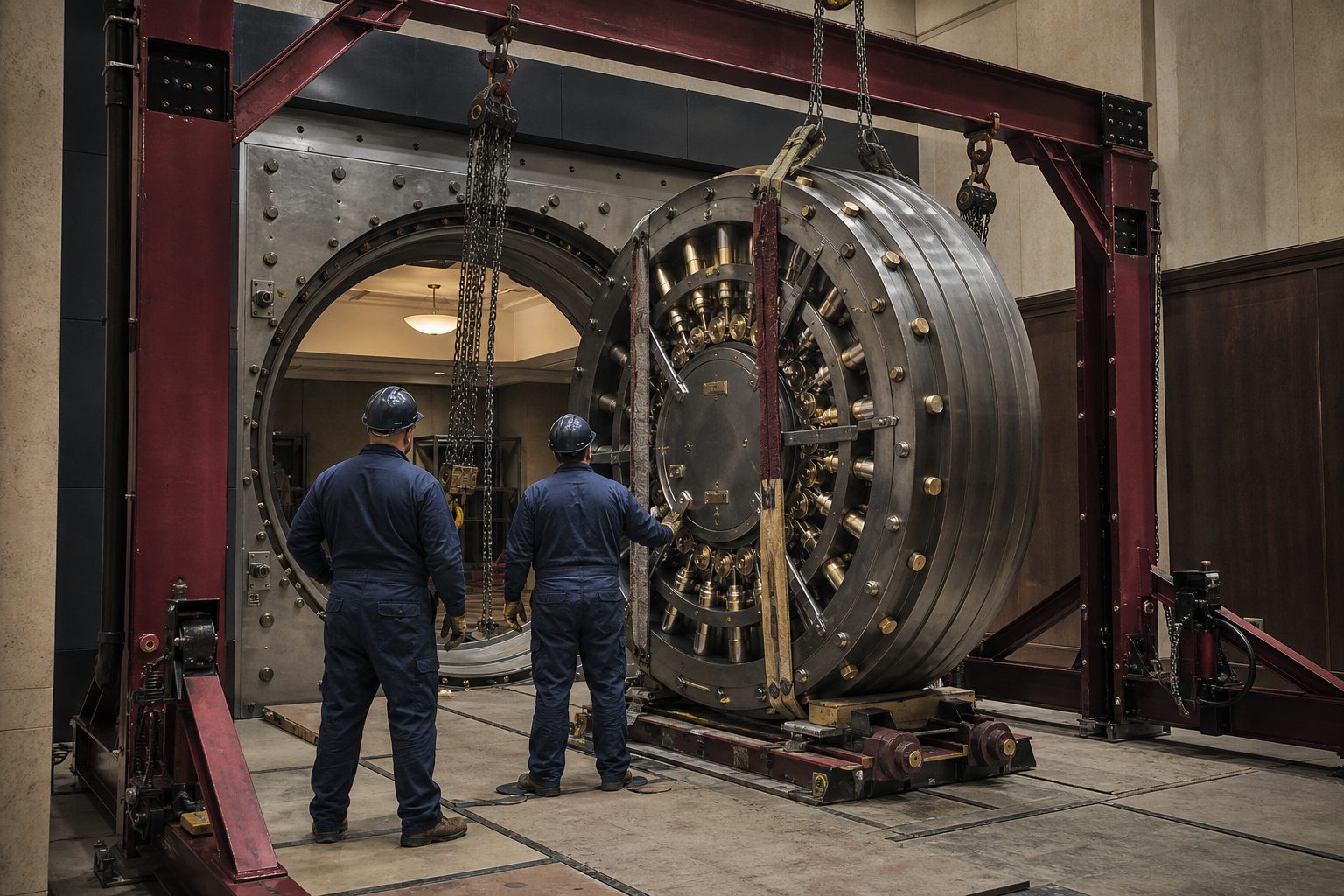
A vault door is one of the few purchases where nearly every expensive mistake happens before delivery. Once the opening is formed and the slab is poured, your options narrow sharply.
Specify the class before you design the room
UL classifies vault doors by resistance time — Class 1, 2 and 3 correspond to thirty minutes, one hour and two hours respectively, with GSA Class 5 sitting in a separate government specification. The class determines the door’s weight and thickness, which determines the frame, which determines the opening.
Architects reasonably assume a door is a door. Send them the manufacturer’s rough-opening drawing early, and make sure your insurer has agreed the class in writing before anyone commits.
The floor has to carry it
Vault doors commonly run from 800lb to well over 4,000lb, concentrated on a small footprint and swinging through an arc. On grade this is rarely an issue. Above grade it needs a structural engineer, not an assumption.
Getting it into the building
We survey the route before quoting, every time. Door widths, corridor turns, elevator capacity, ramp angles, curb height and overhead clearance all decide whether this is a straightforward rig or a job requiring a crane and a removed window.
It is common for the route, not the door, to be the constraint. Finding that out on delivery day is the expensive version.
The walls have to match the door
A two-hour door in a stud-and-drywall wall is decoration. Vault construction standards specify wall, floor and ceiling as a system — usually reinforced concrete of a given thickness, or a modular panel assembly rated to match.
Modular vaults exist precisely for retrofit situations. Panels assemble on site, which gets a genuine vault into rooms that could never take a poured one.
Decide the access details now
- Time lock or time delay? Standard for banking, unhelpful for a business needing access at odd hours.
- Day gate. Almost always worth it. Lets the main door stand open during trading with a barrier still in place.
- Emergency egress. Anyone who can be inside must be able to get out. This is a life-safety requirement, not a preference.
- Ventilation and lighting. Easy to run before the pour, disruptive afterwards.
And plan the service access
Vault doors last decades and need periodic servicing of the lock, boltwork and hinges. Make sure whoever installs it can also service it, and that you know who to call at three in the morning when it will not open.
Not sure where you stand?
We have been specifying and servicing this equipment since 1905. A phone call costs nothing.